

Live fleet visibility —
built for intervention.
Tracking in OneRoad is not just a map. It’s a continuously updating signal layer that feeds the AI Dynamic Dashboard — detecting exceptions and prioritising risk so you can act in real time.
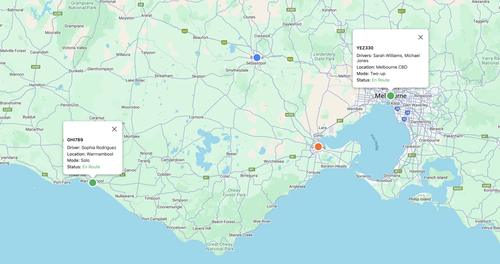
What Tracking delivers
Tracking becomes a real-time operational layer — not a standalone feature.
Live Location & State
Know where assets are and their status: moving, delayed, stopped, or off-route — with updates designed for operational decision-making.
Exception-First Visibility
The system prioritises abnormal events — route deviation, unexpected stoppage, or delay risk — so you manage by priorities, not by scrolling a map.
Linked to Work
Tracking is connected to jobs, runsheets, schedules, and journeys — so every movement has operational meaning inside your supply chain.
Operational Traceability
When an incident occurs, the system provides a defensible timeline: movement history, exception triggers, and actions taken.
How tracking works
Capture Signals
Data flows from OBx or mobile app.
Add Context
Linked to runsheets, routes & schedules.
Detect Exceptions
Deviations and delays rise automatically.
Drive Action
Reroute or investigate with one click.
Tracking connects everything.
Tracking becomes powerful when it is correlated with the systems that cause disruption.
Why this matters
In regulated supply chains, location alone isn’t the value — it’s what location implies: route legality, fatigue exposure, and delivery risk.
OneRoad turns tracking into a decision layer that continuously informs compliance posture and operational performance.
See your fleet as a live system.
Tracking is just the start — OneRoad turns movement into orchestration.